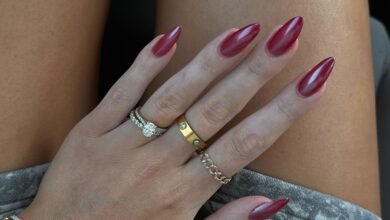

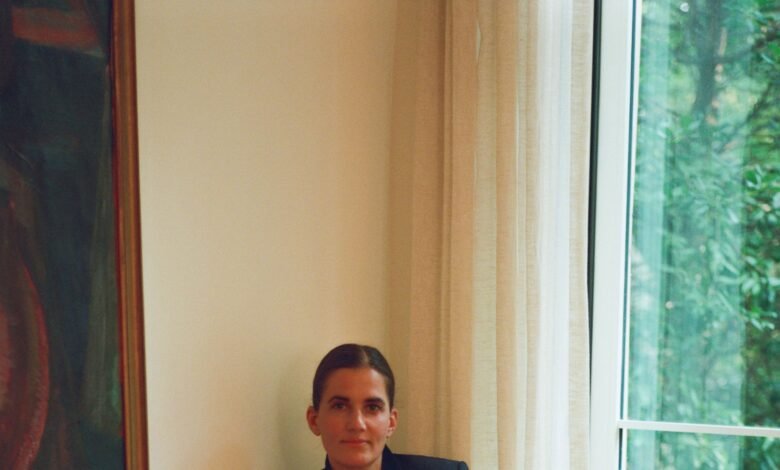
Before her preventative double mastectomy, artist and designer Carly Berlin’s favorite brand to shop was Kallmeyer. Post-double mastectomy, Kallmeyer remained a favorite, thanks to the adaptability of many of the brand’s garments. “Just because something is functional doesn’t mean that it can’t be beautiful. You see that all the time in interior design, but it’s really not a part of the conversation in fashion,” Berlin says.
Recovering from her surgery, she wondered why the tie between functionality and beauty remained so underexamined in fashion. She connected with other women going through surgeries, treatments, and moments of physical change — and nobody knew where to look for fashion in these moments. In the wake of her mastectomy, Berlin lived in Skims and Negative Underwear — and then gifted those same pieces to friends going through their own transitionary moments.
After sending so many of her contacts the pieces she had discovered during hours of searching, Berlin decided to create the discovery layer for pieces that are tasteful, beautiful, and, most importantly, wearable. The result is Weldun: a luxury fashion marketplace built for women whose bodies change throughout their lives, whether down to surgery and illness, pregnancy, or aging and menopause.
Pieces are curated and sorted into four functionality
Pieces are curated and sorted into four functionality categories: Easy On / Easy Off, Healing and Recovery, Sensory-Considered, and Flexible Fit (though shoppers can also simply sort by traditional filters such as ‘tops’ and ‘bottoms’). The key is that Weldun doesn’t only stock clothing purpose-built for accessibility and functionality. Instead, items from your usual luxury fashion brands are curated and recontextualized, highlighting aspects of accessibility and functionality.
Weldun’s founding collective includes brands such as Kallmeyer, Another Tomorrow, Mansur Gavriel, H-O-R-S-E, Still Here, and Underwater Weaving Studio. For H-O-R-S-E founder Sue Williamson, Weldun’s premise that one shouldn’t have to choose function and comfort over style resonated. “I was diagnosed with cancer a few years ago and have had several surgeries and treatments that have altered my body and mobility at times,” she says.
“Fashion can seem trivial to some, but being able to express myself through clothing helped me maintain my sense of identity, which was huge.”
Weldun operates as a marketplace: the user transacts on the Weldun site, which triggers the order from the brand partner, who does the fulfillment. But the relationship is built on the Weldun platform. Berlin is confident that, by catering to and speaking to its customers in a way that other sites aren’t (either by being overly clinical or not speaking to their changing needs at all), they’ll keep coming back.
The global adaptive clothing market is projected
The global adaptive clothing market is projected to grow from $1.53 billion in 2025 to $2.65 billion by 2033. According to a white paper released by Sinéad Burke last year, the disabled community accounts for $2.6 trillion in disposable income across the US, Canada, the UK, and the EU, with a growing population of 1.3 billion. And adaptive fashion accounts for $400 billion in the US alone.
The reality is that these statistics likely don’t even include the bulk of the clothing stocked on Weldun, which isn’t technically classified as adaptive, but is part of brands’ existing ready-to-wear collections. Over the years, platforms have launched that cater to this intersection, but staying the course has proved tough. Adaptista launched in 2022 with the goal of being the ‘Farfetch of the adaptive clothing market’, but has since pivoted from marketplace to developing its own lines.
Juniper Unlimited before it (which Burke was on board with) was also short-lived after its financial backer, Global Brands Group (GBG), collapsed. Still, Berlin is strong in her conviction that there is ample room for growth in this sector. “Looking at the market size, this is not a niche experience,” she says. “Physical change or evolving physical needs are something we all experience at some point in our lives.
Looking at it through this lens of fashion,
Looking at it through this lens of fashion, so many of these products already existed so naturally within a lot of these brands’ offerings.”
The taste level also means that these are items people will want to wear beyond a particular moment in time, Berlin adds. “That’s the beauty of the brands that we’re working with, the products that we have: they are so design-forward and quality-made that you will want to have them in your closet for time to come.”
The timing is right, says KR Liu, global head of product innovation and marketing partnerships at Google, who is one of Weldun’s advisors.
“The technology, the creative appetite, and the cultural readiness have all aligned to make a platform like Weldun not just possible, but natural,” she says. “There is such an exciting opportunity right now for luxury to rediscover what it does best: crafting garments that bring effortless ease to the wearer.”
Weldun raised a friends-and-family funding round pre-launch, and has a second allocation of that round committed for this fall.
Berlin expects to raise Weldun’s first institutional round in the middle of 2027. All-inclusive accessibility
Weldun was built in partnership with a group of advisors and partners who informed everything from the website design to the language used throughout the platform. Liu, Christina Mallon, director of inclusive design at Microsoft and a board member of Open Style Lab, Maura Horton, founder of MagnaReady and the inventor of the magnetic-closure technology, and Burke, founder of strategic accessibility consultancy Tilting the Lens, have all had a hand in the building of Weldun, and will continue to do so as the company grows.
The initial clothing selection was informed by interviews
The initial clothing selection was informed by interviews with women and people across all kinds of lived experience, from surgery recovery to life-long disabilities. While most products are curated by the Weldun team, there’s also brand input. Some aspects are so subtle within the design process that they may not appear on a line sheet, Berlin says. “We want to be able to ask questions to our brand partners so they can say, ‘oh, actually there are these hidden snaps that could be functional for X, Y, and Z purposes’.” This working relationship will evolve with the platform, she adds.
H-O-R-S-E’s Williamson, for instance, hadn’t thought of her designs as ‘accessible’ prior to this, but the goal was always to make comfortable, functional clothing. Elements of the clothes, it turned out, were indeed conducive to changing bodies. “There are design elements inspired by my own needs — oversized sleeves to go around a port-a-cath I used to have implanted in my arm, for example — but we design for function and fashion equally.”
The same goes for every aspect of how Weldun’s business runs, from the backend to the website design.
For this reason, Berlin emphasizes that Weldun’s four functionality categories are flexible. “We share what our definition is of each of those categories, and then we allow our customer to educate based on the information that we give them, and then they can identify what is going to be best for them.”
Telling the story
Though the marketplace will be Weldun’s money-maker, to Berlin, it’s just the entry point.
Alongside the shopping feature, Weldun is also launching
Alongside the shopping feature, Weldun is also launching Wel Said, an editorial and newsletter platform designed to both contextualize Weldun’s products and to profile women who align with the platform’s mission. “The editorial gives us this unique opportunity to re-contextualize these products through a specific lens,” Berlin says. The team will conduct ‘curated closets’ interviews with people with diverse lived experiences.
For instance, someone getting shoulder surgery will highlight the pieces that were beneficial to them, which will then link back out to the Weldun marketplace. There’ll also be a quarterly Weldun Voices series, profiling women who have made a mark on culture, who can speak to the impact (or lack thereof) of their changing bodies on their work. First up is Gloria Steinem, who died at her home in New York on September 2.
“She’s obviously incredible, and embodies all of the seasons of a woman’s life at 93 years old. She really speaks to the aging population. She experienced breast cancer. And so for her to be the first is [important].”
After her passing, Berlin said: “Gloria’s loss is immeasurable. She changed the way generations of women saw themselves and what was possible for their lives.
I feel extraordinarily lucky to have spent time
I feel extraordinarily lucky to have spent time with her, to have learned from her, and to know that she believed in what we’re building with Weldun. That is something I’ll carry with me forever.”
Berlin hopes that this editorialization will help Weldun speak to the type of customer they’re looking to capture: the woman who has a strong sense of style and affinity for luxury, that she doesn’t want to sacrifice for her changing needs.
“It’s important that we’re creating a visual identity and a vocabulary that makes it easy for people to buy in and emotionally connect to what we’re doing,” she says. “There can be a need, but if you’re not successfully speaking to the customer and speaking their language, then you’re not able to capture them.”
It’s a wide audience, which is also where the storytelling will help Weldun zero in.
“The editorial aspect of things will really bring things in to connect to those more micro moments, whether they’re recovering from a C-section or they’re going through menopause or living with arthritis and have limited dexterity.”
A new normal
Looking forward, Berlin hopes Weldun can help to shift the narrative — and, in turn, the availability — of fashion that is functional and accessible to people across life stages and changes.
Up next is to onboard more brand partners
Up next is to onboard more brand partners. From there, Berlin hopes to collaborate more closely with brands, based on the learnings and insights Weldun gathers from its customers about their needs and wants. She’s not ruling out product design of Weldun’s own, either, should there be demand for ultra-specific items not available Weldun will be able to collate about consumers and their needs
“No one has really understood this consumer, in this context, at this scale,” she says. “While so many of the solutions already exist, these brands aren’t currently speaking to that customer. We have an opportunity to share those trends, to share this insight with our brand partners to inform their future product innovations.”
To date, Kallmeyer’s Daniella Kallmeyer has thought of her designs as accessible, in a different way.
“We talk about inclusivity, comfort, wearability, size inclusivity a lot as part of our methods of wardrobe building and sustainability,” she says. “Adding this criteria and also the pressure to serve a huge portion of the population that this is a need for is an added point of categorization, but also inspiration for us when we go into thinking about what is next for the brand.”
Working with accessibility in mind has changed the way Berlin thinks, and she hopes for the same for more of Weldun’s partners.
For better or for worse, I’m always like,
“For better or for worse, I’m always like, ‘Oh my gosh, these buttons are too tiny’. You take into consideration someone that has limited dexterity or tremors or a limb difference,” she says. “There are so many opportunities for fashion as a whole and the designers within it to make really thoughtful, subtle tweaks that ultimately will benefit everybody.”
Inclusive design is, after all, the end goal.
More from this author:
Beyond Lab-Grown: How Dorsey Is Building a New Kind of Jewelry Brand
Which Summer Breakout Stars Will Be Front Row This Fashion Month? Why Diptyque Is Making a Bigger Bet on Bodycare
Source: www.vogue.com